A letter to Micu, and the story behind the song
Hei Micu,
I have been thinking quite a bit about you. I wonder where you are and what you are up to. I like to think that if you could, you would come back and fill me in from time to time. Maybe you are, in some strange way. I want to tell you a story. The story of a song I wrote the other day, the story of the birth of “Levels of Pain.” If I am honest, it feels less like something I created and more like something we uncovered together, as if it had been waiting beneath the surface of our lives.
It began with pain, real visceral pain. It began with a ski trip beneath a pale winter sky, with breath turning to frost in the cold air, and with a question.
A question that unraveled memory.
A question that carried me back to the hospital, this time with you as the patient.
A question that summoned the late night conversations we shared in the quiet corridors of Juravinski Hospital.
A question that thinned the veil of time.
It was a question I was asked again and again in the sterile glow of hospital rooms after my motorcycle accident on May 29, 2023. A question that followed me through shattered bone and failed surgeries, through long nights when pain stretched the hours into something without edge or mercy.
And it was the same question that returned in the final months of your life, spoken softly beside your bed, rising through the hum of machines and the fragile rhythm of borrowed breath.
“On a scale from one to ten, how would you rate your pain?”
At first it felt practical. A number. A box to be checked. A way to measure something that refuses all measure.
But over time it became something else. It became a rhythm. A ladder rising through shadow. A language we both had to learn.
A language we came to speak fluently.
A language written in breath and bone.
A language many of us carry, whether we wish to or not.
There are so many things I want to tell you. And I am late in telling them.
I meant to say them while there was still time. But you went quickly. Priorities shifted overnight. The days narrowed. And somehow, I ran out of time.
I tried to say what I could by simply being there. By sitting beside you in those final stretches of the road. By showing up as often and as long as I could.
I remember how you told me that you had not been a good father. That you had not imparted any great lessons. That there was nothing you could point to and say, “My children know this because I taught it to them.” No grand teachings. No clear inheritance of wisdom.
You were wrong.
At least for me, you were there in the ways that matter most. You were always my Plan B, whether you knew it or not. And that is no small thing. Plan B is salvation when Plan A collapses. It is the quiet assurance that if the ground gives way, someone will still be standing. It is the lifeline that allows a person to take risks, to grow, to step into the unknown without being consumed by it.
It is the safety net so many never have. You were pure strength for me. I saw you as invincible.
Plan B
I think you taught me that lesson when I was very young, in a way that was anything but abstract. I am sure you remember our boat trip on the River Lăpuș in Romania, when our inflatable boat wrapped around a tree and hurled us into the wild current.
I do not remember everything. Memory from that age is scattered and fragmented. But I remember calling for you. I remember you being there. I remember your hands pulling me out of the water. I remember the blood on your legs from the stones you threw yourself onto to reach me.
Most of all, I remember feeling safe.
In that moment, without speeches or instruction, you showed me what it means to be there. Not conditionally. Not conveniently. But completely.
You taught me that lesson again years later, when I left home to live with Mom without telling you. I do not remember that period as a happy one or a sad one for that matter. But I remember that morning in Bucharest, when I walked toward school and saw you there. You had tracked me down. You had found me.
I think that may be one of the happiest and most formative memories I carry. I had missed you more than I knew how to say.
I remember seeing you there, smiling, your arms wide open. I remember running toward you without hesitation, throwing myself into your embrace. I remember the feeling of being lifted, of being gathered in.
I remember pure joy.
I tried to tell you some of these things during those long hospital nights. I remember thinking they deserve to be written, to be set down in the form of a letter. I meant to do it then. Instead, I am writing it now.
And even as I write, the question returns and echoes in my mind. “How would you rate your pain?”
It is not physical pain I am listening to now. It is something quieter. Thinking of you. A pain of the soul. A pain of time, maybe, and the strange distance it keeps placing between us. Not only the distance of death, but the distance of forgetting. Each day I am sure there are small things that slip away. Your face. Your smile. The little habits that used to annoy me. The exact sound of your voice when you were amused, or annoyed, or critical of something. I fear that one day you will be only an outline, a passing thought, or perhaps not even that. I do not know. My memory has never been reliable over the long haul.
But pain has a way of becoming memory. It roots us. It steadies us. It builds its own kind of fortress within us. What is carved in pain is rarely forgotten. So I will use this pain to carve memories of you, to hold them and treasure them and keep them with me. I will use pain as an anchor, a way of binding your life to mine. And I have plenty of it, in every single step.
And I return to the question. “On a scale from one to ten, how would you rate your pain?”
When I lay in that hospital bed after my motorcycle accident, when the surgeries failed, when the hardware broke and the pain refused to loosen its grip, I answered that question honestly. Sometimes through clenched teeth. Sometimes in exhaustion. Sometimes not knowing what number could possibly contain what I was feeling.
And then, not long ago, I stood beside your bed and heard them ask you the same thing.
Christmas morning
I remember your face behind the oxygen mask. I remember how tired you looked, and how you still tried to be strong when you answered. I remember the exhaustion in you, the kind that sits deeper than the body. I remember when you asked me to take a photo of you that Christmas morning, on your last day. It was the last photo I took of you while you were still yourself. As distressing as it is to look at, I will treasure it. Thank you for asking me to take it. I do not think I would have otherwise.
I do not know why you asked. You seemed almost amused by the situation you were in, as if you could still stand a little outside it and watch it with humor. Maybe you thought we would look at it later and laugh. Maybe you knew I would need it. A proof of your courage. A reminder of how brave you were, that last day, stepping into the unknown.
I remember the distress when they hooked you up to the larger oxygen machine. I wonder now what I would have done if I had known it was your last day. I wonder if I would have spoken differently, touched your hand longer. Part of me, I am ashamed to admit, was annoyed about missing Christmas dinner.
I remember every time you struggled to pee that day. I remember how hard it was for you, how each attempt became another small battle, and how often nothing happened at all. I think I had a hunch it would be soon. I think some part of me even welcomed it, not because I wanted you gone, but because I could not bear watching you fight for every breath. I hated that you could not find a moment of peace.
I wanted them to sedate you and intubate you so you would not have to fight anymore. You did not want that. I think you made up your mind after being on that machine that you did not want any more interventions like that. You wanted to go out on your terms.
I am glad Karina brought the girls to see you. I do not know what they will remember, or what it will mean to them later on, but I hope that visit meant something to you, and that some part of you felt held by it.
I am grateful for those last moments when the drugs gave you some relief and I like to think I even saw you smile one more time. I will remember the last words you spoke, “Hai sa mai dormim un pic!” “Let’s get some more sleep.” I will always remember the awkward heart you tried to shape with your hands, the one that looked more like an infinity symbol than a heart. I will remember your warm hands. Always warm.
Only now I begin to understand how tightly our stories had braided together, and how our shared pain gave rise to this letter, and to the song.
The ski trip
It seems I needed this ski trip. One more reminder, perhaps at a critical time, before forgetting could fully settle in. A time to inscribe something into the book of my life. A reminder. Not the kind that breaks bone or steals breath, but something smaller and sharper. A fresh edge of physical pain to bring me back into that familiar landscape. And again, it arrived through the bond between parent and child.
This time, I was the father.
On a beautiful and frigid morning, February 1, 2026, I took my daughter, Clara, skiing. She is nine years old. Probably the same age I was when we went on our boat trip.
The sky was impossibly blue, the snow bright as glass. The air was sharp with cold, yet the sun hung warm and steady above us. Her excitement was palpable. It reminded me of a few moments from my own childhood when joy felt that pure and uncomplicated.
I remember one in particular. After my appendix operation, you took me with you on a work trip. We ate at a restaurant, and it felt like an adventure. I remember how special that small thing felt. How seen I felt.
Clara was laughing, buzzing with energy, eager to spend the day with her dad on the slopes. So off we went. She was excited, and I was worried.
Getting my foot into the ski boot was its own quiet battle. The bones never healed properly. The hardware that remains inside me shifts and presses where it should not. I knew the risk. I knew the cost. But I wanted to stand beside her on that hill. I wanted to give her that small joy. I wanted to be there with her, to teach her, to guide her.
The walk to the hill felt like light fighting a war against the Klingon Empire. I was sweating in minus ten degrees, heat rising from a body under siege. Pain has a strange way of making you feel both overheated and hollow at the same time.
Time began to dilate in that familiar way. The short walk stretched into something endless. Pain is a powerful alchemist. It thickens the air. It slows the clock. Add enough of it, and a moment can feel like eternity.
We made it to the hill. The ten minute wait for the chairlift felt like hours. I imagined the ride up might bring some relief, a brief reprieve from the pressure. It did not. If anything, it sharpened the ache. The boot pressed against bone that never healed, against metal that still lives where it should not. Whether my foot rested on the snow or hung suspended in the air made little difference. The pain remained steady, indifferent to gravity.
We made three small runs.
With each descent, the pain climbed. It tightened around my ankle, then around my breath. By the third run, I could barely speak. I recognized the territory. I had lived there before.
And then something unexpected happened.
She looked at me carefully and said, with a calm I did not expect from someone so young, that we could go home, that we should go home. She had tears in her eyes. She said she did not like seeing me in pain. That it made her sad. She said we did not have to stay. She told me that she loves spending time with me. She knows how to ski already, and she loves that she learned from me. She told me we could find something else to do together. Maybe a project in the garage.
There was no drama in her voice. No disappointment. Only care.
It was not like the river. There was no current pulling us under. No blood on stones. But in a quieter and more profound way, she was the stronger one that day.
So we packed up and went home. She came with me to the mechanic for an oil change on the van. While we waited, we sat in the car and played Sudoku on my phone. I showed her little tips and tricks, and she listened carefully, determined to get it right.
She remembers that afternoon fondly. She says we did Sudoku together at the mechanic and that it was fun. She was so patient, so focused, even in a place that would bore most nine year olds within minutes.
It was not the adventure she expected, but it became one she treasures anyway.
There was something beautiful about that ordinary moment. No heroics. No rescue. Just presence.
In some quiet way, our roles shifted that day. I saw myself again as a child, looking toward you. And I saw her looking toward me, her father, measuring something she could not yet name.
I find myself hoping that I can inspire in her what you inspired in me. That sense of security. That quiet certainty that there is always a Plan B. Not just as a father marked by pain, limited in the things I can do. Not only as the careful man with the broken foot.
But as someone steady. Someone she can lean on without hesitation.
It is strange to look at myself through her eyes, and through yours. The lines begin to overlap, as if time folds in on itself. Father and son. Father and daughter. Patterns repeating across generations, only revealing their shape when we step back far enough to see them.
The landscape of pain
Going back to this idea of pain, I had known pain before. Small encounters and larger ones. Do you remember the plantar wart on the bottom of my right foot that I carried for seven years. That was a long test of endurance.
I remember a particularly brutal episode on a New Year’s Eve in Cuba. The infection set in. Red streaks climbed up my leg toward the knee. The doctors would not touch it. They gave me antibiotics, but the pain became something primal. It narrowed the world to a single point of pressure.
Relu managed to get razor blades, and I cut open the sole of my foot. I was desperate for relief. When the pressure finally released and the infection drained, the relief was immediate, almost shocking.
CORRECTION (2026-02-06): Look above for a moment. Notice the name Relu. A small side note, just to prove how unreliable my memory can be. Karina read this post this morning and informed me that it was not Relu who got me the razor blades. It was her. But, just like President Trump, President Karina also never gets any credit either. 🙂
Even with all of that in the rear view mirror, what came after the accident was something else entirely. It was not an episode. It was not a sharp crisis with a beginning and an end. It was a landscape. And I was not prepared for it.
Do you remember how we used to joke that after you were gone, I would still see you riding your motorcycle ahead of me. I actually do sometimes. I miss the bike. I miss our rides.
Karina once told me that I am free to get back on the bike if I want, but if I fall again, she is not staying for part two. There was a saying she used. Something about fool me once, fool me twice. I cannot remember the exact words, but I understood the meaning.
It may be that my riding days are over. It may be that the motorcycle has served its purpose. It may be that it will never hold the same appeal without you.
I remember how you reacted when I told you I was getting my motorcycle license. You were excited like a child on Christmas morning. I remember the first motorcycle I bought and the first time I let you ride it. You were so eager to get on. The speed took you by surprise and for a second I thought you might crash into a parked car. You came back grinning anyway, lit up by it. You were so excited to get your own license. It was not that you had never had the opportunity before. It was that the idea of doing it together sparked something in you.
Your first instinct was to jump on the bandwagon. As I remember it, you got your license shortly after me. And that is how we became riding buddies.
I never really rode with anyone else apart from the occasional ride with Karina. And you did not either.
Perhaps it was never only about the road. Or the machines. Perhaps it was always about freedom. About riding together. About choosing movement and horizon.
I think that was always the part I looked forward to most. The time we spent. The camping. The stops between stretches of asphalt.
I have been thinking about our last motorcycle camping adventure. It was supposed to be a long ride through Ontario and Quebec. Instead, it became a short trip to a provincial park, where we stayed for all the days we had planned.
On our way there I noticed my rear tire was in terrible shape. The tread was gone in places. I could see the wire mesh showing through. It was not safe to ride, and I could not find a replacement. On the way home, I wrapped duct tape around the tire to keep it from wearing down further. I like to think it helped.
It was a great trip. Not because of the miles we rode. Not because of the road itself. That part was quieted by the tension of the failing tire. But because we stayed.
We fished. We talked. We cooked. We sat around the fire. We did forest things. Camping things. The simple rituals that stretch time and soften it.
Now that you are gone, I wonder if it is time to let go of the motorcycle. I do not know when or where I would ride again. Perhaps in another life.
Maybe I will take up horseback riding instead. Something even wilder. Something freer. A partnership in motion, where the road is not faced alone.
The accident
These thoughts bring me back to the day of the accident, and to that last trip we took together.
As always, you were riding ahead of me on that warm day in May. I was close behind when disaster struck. It was beautiful out. A perfect day. We had just crossed into New York State and put our helmets on. Up to that point we had been riding without them. I had music in my headphones, and I remember exactly what was playing. An ABBA song, “Mamma Mia.” I have not listened to it since. Writing this now, I stopped and played it again for the first time since that day, and it felt like opening a sealed room. The lyrics in particular were striking for me. Give it a listen when you have a chance. Here is the link.
I remember the moment I hit the ground, the motorcycle bucking and flying out from under me. I remember looking at my right foot and thinking, with strange calm, that it looked wrong. It was pointing the other way. My first instinct was practical, almost absurdly so. Turn it back. I remember pausing, trying to decide which direction to rotate it. I had to trace the creases of the skin to find the right orientation, like a person trying to solve a small puzzle while the world is on fire. Then I did it.
The next order of business was to get off the road. That proved harder. I took inventory of my limbs. They were all there, but they were not cooperating. I seemed to have my left hand, so I started to move the only way I could, squirming in a kind of worm fashion. I remember thinking it was comical. I remember thinking, very clearly, that I would not enjoy being a worm.
I was not afraid at that time. I was not even in pain at first. My thoughts were of you. I was worried you would blame yourself. I asked you not to. I told you I was at peace with what happened. I meant it then. I mean it now.
The accident did not take something from me without giving something back. It taught me patience. It taught me endurance. It taught me humility. It slowed me down in ways I did not know I needed. It changed how I see my daughters and Karina. It changed how I measure strength. It changed a great many things.
I would not undo it.
So when you told me, near the end, that my accident was your greatest source of guilt and regret, my heart broke in a way I did not expect. Not because of the accident, but because you carried that weight alone, even after I tried to take it from you. I suppose I should have known that guilt often works that way. We make our own punishments, and then we carry them.
Micu, I need you to hear this again.
You did not take anything from me.
You did not ruin anything.
You did not fail me.
You rode four hours home, then four hours back, then four hours again. You did not sleep. You just showed up. That is who you were. Steady. Responsible. Quietly strong.
If there was pain in our story, it was not your fault. It was part of the road. Part of life. Part of being human.
When I wrote “Levels of Pain,” I realized something. The scale from one to ten is not just about suffering. It is about endurance. It is about love that refuses to step away. It is about parents and children standing beside each other in hospital rooms and on highways and ski hills.
It is about breath.
You rode ahead of me once.
I stood beside you at the end.
We walked each other through our hardest numbers.
And I carry that with gratitude, not regret.
There is something about the human condition. I do not think we ever experience life without some level of pain, physical or otherwise. When I wrote the song, I first set the scale from three to ten because I suspect most of us live our days at three. Not absent of pain, just living with a low hum of it, so familiar we stop naming it.
Pain can be damage, but it can also be memory. It marks the places that mattered. It presses experience into the body so it will not drift away. And without pain, happiness would be harder to recognize, because contrast is part of how we see. Pain comes in many forms, sharp and dull, brief and lasting, physical and invisible. It does not only hurt. It measures us, even as we try to measure it.
Timing, Tarot, and the second melody line
I want to reflect a little on the timing of this letter through the lens of mythology and the Tarot de Marseille. I do not offer this as proof of anything. I offer it the way I have offered everything else here, as pattern, as resonance, as a way of giving the days a second melody line.
I wrote the song on February 2, 2026. Two is the day of II, La Papesse. I associate her with Selene, the Moon, and with the hidden book, the book of life that is written quietly in the dark. The Papesse does not perform. She keeps the record. She holds what is secret, what is true, what is remembered beneath the noise. It feels as if that day I wrote a page in our book of life, a page to remember, set down under a Titaness of the moon.
On the 3rd, a day of III, L’Impératrice, the Empress, whom I associate with Demeter, I began writing this letter. That also feels right. Demeter is the life of the world. She is the green force that insists. She is the seasons. She is descent and return. She is the mother who searches. If the Papesse is the book, Demeter is the living ink. She is what makes memory fertile instead of sterile. She is what turns grief into something that can feed us.
On the 4th, a day of IIII, L’Empereur, whom I link to Ares and Mars, the structure of the world, I took a break from the letter. The Emperor is the frame. The boundary. The bones under the body. If Demeter is the feminine aspect of life, Mars is the masculine principle of form. The part of us that builds, measures, stabilizes. It makes sense to me that on the Emperor’s day I stepped away from the raw, inward work of writing, and turned toward making something that could be held.
That was the day I worked on a different project that had been lingering in my mind. I designed a program to create a life signature. I started from a simple idea. We are born at a specific spot on the planet. Over a lifetime we travel from place to place, and our path leaves a trail. But that trail is not drawn on a still map. The Earth rotates on its axis. It circles the Sun. The Sun and our solar system travels through the galaxy. A human life is not only a line across countries. It is a curve through moving space, a thread laid into a spinning world.
So I created a mathematical program that, given coordinates and dates and times, traces a person’s path to create a life signature. This is what came up. A spiral within a spiral. Here is the photo.
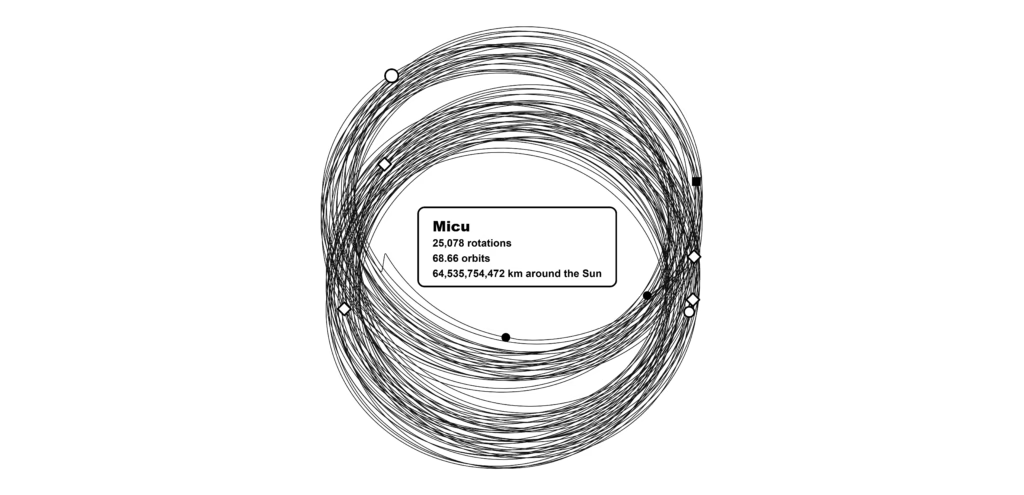
This is what I did on the 4th day. The Emperor’s work. Turning motion into form. Turning a life into a mark.
And now, on the 5th day, a day of V, Le Pape, whom I associate with Hermes, I am writing you this letter and this interpretation. That also feels fitting. Hermes is the messenger and the translator. The one who can move between worlds without getting lost. The one who knows the roads. The one who carries words across thresholds. If there is an archetype that can gather all of this and bind it into something communicable, it is Hermes. He is the bridge between the living and the dead, between the raw experience and the story we make from it.
It seems right that Hermes would wrap this small project. He is the one who seals it, not with finality, but with passage.
I will make the program public as well. My intent is to use a laser to engrave your life signature onto a piece of metal. Something durable. Something that can be touched. A physical emblem of the trail you left through this moving world. Not a tombstone, but a talisman. Not an ending, but a mark that says, you were here, and your path still shapes mine.
Lyrics
In the end, I want to leave the lyrics here in the body of this letter, the way you might press a leaf into a book.
LEVELS OF PAIN
Intro
Tell me, on a scale from one to ten, how would you rate your pain?
Verse 1
We’re born with lungs that have to learn,
From fluid into breath we turn,
Before we know what living means,
We gasp in pain between the seams.
Chorus
One to three begins the game,
Four to seven feeds the flame,
After seven, night begins,
Time expands to hear my screams.
Ladder
One.
Is where the pain begins.
Two.
The baseline settles in.
Three.
Is normal for us all.
Four.
Is where I can’t ignore.
Five.
I feel I lost my spark.
Six.
Has led me to the dark.
Seven.
I can’t even speak.
Eight.
I lost my way to think.
Nine.
There is so little sleep.
Nine point five.
I lost my fear.
Ten.
I can feel the end is near.
Verse 2
Me and you, we are old friends,
In a loop that never ends,
Some will say you’re teaching me,
I would ask you, let me be.
Chorus
One to three begins the game,
Four to seven feeds the flame,
After seven, night begins,
Time expands to hear my screams.
Verse 3
Am I dreaming while awake?
Is this body real or fake?
If we suffer just to live,
What is left for us to give?
Outro
Release me.
What it means to me
It begins where the hospital begins, with that dry clinical question that pretends pain is a number you can hold still long enough to measure. One to ten. As if suffering were a neat line. As if it rose politely. As if a person could translate the whole storm of the body into a single digit without losing the truth of it.
But I also understand why they ask it. When you are standing at the edge of someone else’s suffering, you need a bridge. You need a shared language. You need a scale, because without a scale you are helpless. The question is not cruel. It is the best tool medicine has for something that cannot be seen.
And yet, for me, that question became a doorway. Because pain is not only physical. Pain is emotional. Pain is memory. Pain is the way the soul keeps score. Pain is also the way time announces itself. Time passes, and the body and heart register it.
Verse 1 goes all the way back to the beginning, because pain begins at the beginning. Birth itself is the first threshold. We come out of fluid into air, out of the womb into the world, and the first proof that we are alive is a gasp. Before we have language, we have lungs. Before we have meaning, we have sensation. The song says, even before we know what living means, we are already learning pain. Not as punishment, but as initiation. We arrive through strain. We arrive through rupture. We arrive through the seam.
Then the chorus lays down its mythic structure. One to three begins the game. That is the low hum of ordinary human life. The background ache, the small griefs, the compromises, the wear and tear, the quiet disappointments, the bruises we do not name. It is the pain we get so used to that we forget it is there.
Four to seven feeds the flame. This is where pain stops being background and starts taking the foreground. This is where it begins to narrow the world. Four is the moment you cannot ignore it. Five is the moment you feel something in you dim. Six is the moment the horizon darkens. Seven is the moment your voice leaves you. It is not only that it hurts. It is that it changes who you are allowed to be.
After seven, night begins. That line is true in a way that almost scares me. Past a certain point, pain is not just sensation. It becomes a country you live in. It bends time. Minutes stretch. The body becomes the only universe. The mind becomes a room with no windows. Time expands to hear my screams is not exaggeration. Anyone who has suffered knows it. Pain dilates time the way the Moon pulls tides. It makes a day feel endless. It makes a night feel like a life.
Then comes the Ladder, which is the part of the song that feels most like a spell. Counting is what you do when you cannot do anything else. Counting is how you stay present. Counting is how you endure. Each number is a rung. Each rung is a condition of the self.
One is where the pain begins. Not dramatic, just the first signal.
Two is the baseline. The pain becomes part of the background.
Three is normal, the line that terrifies me the most, because it suggests we can live at three and call it life.
Four is the moment denial ends.
Five is the loss of spark, the loss of ease, the loss of the self you thought you were.
Six is the dark, where you begin to bargain with reality.
Seven is the loss of speech, when your suffering becomes too concentrated to translate.
Eight is the loss of thought, when even the mind cannot hold the shape of it.
Nine is the loss of sleep, and without sleep, the walls thin.
Nine point five is the moment fear leaves. That one matters to me. It is not that things are better. It is that fear no longer has room. Something else takes over, something cold and clear. A kind of surrender. I have lost my fear a number of times now. I have been at nine point five.
Ten is the end being near. Not always death, but an ending. A threshold. A cliff edge. A point where something has to change.
That is what I heard in you at the end. Not only pain, but the movement through pain. The way the self is pared down. The way dignity becomes smaller and more luminous. The way the will chooses what it will and will not endure.
Verse 2 is where the song speaks directly to pain as if it were a person. Me and you, we are old friends. That line is honest, and it makes me angry too, because it is true. Pain returns. Pain loops. Some will say it teaches. Sometimes it does. Sometimes it only takes. So the line I would ask you, let me be is the prayer at the center of the song. Not a noble prayer. A human one. The plea for a quiet life. The plea for mercy.
Verse 3 turns surreal, because severe pain is surreal. Am I dreaming while awake. Is this body real or fake. When the nervous system is on fire, reality becomes questionable. You can feel disembodied. You can feel trapped. You can feel like you are watching your own suffering from a strange distance, like a person in a dream trying to wake up.
And then the hardest question in the song lands. If we suffer just to live, what is left for us to give?
That is not a philosophical question. It is a bedside question. It is the question a person asks when the cost of staying alive begins to exceed the resources they have left to pay with. It is the question you were approaching, whether you said it out loud or not. It is the question I was forced to touch when I watched you fight for breath.
The outro is simple. Release me.
It can mean relief from pain.
It can mean release from guilt.
It can mean release from the body.
It can mean release from the loop.
And for me, it also means something else. It means release into memory, so that what hurt does not vanish, but becomes part of the story we carry, part of the book we write, part of the love that remains when the body is gone.
That is why I put these lyrics here. Not to dramatize suffering, but to witness it. To give it shape. To turn it, as best I can, into something that holds.
Something tells me that I will write to you again. But for now, this will suffice.
Te iubesc, Micu.