A myth for a man I loved, and the ritual that taught me how to keep walking.
We live in a mathematical reality.
Time moves us, and dates shape us. We are surrounded by numerical patterns. They describe the world we live in and the flow of what we do. It is like a matrix, not as a prison, but as a living lattice, a kind of hidden architecture that holds experience in place long enough for meaning to form.
There are days that behave less like time and more like doorways.
Not because the world announces them, nor because the calendar insists. But because, if you step into them with your whole attention, the air changes. The ordinary becomes transparent. The edges of things start to shimmer, like heat rising above stone.
Lately, I have been treating dates the way some people treat coastlines: not as mere markers, but as places where currents meet. If I stand there long enough, patterns wash up. A number mirrors itself. A name reveals an older root. A myth slips over a real place like light over water. The fit feels exact, as if it had been waiting for someone to notice it.
My father passed through the veil on 2025-12-26, the day after Christmas.
I wrote him a song on 2026-01-10 and released it on 2026-01-11, offering no explanation, because some offerings do not require one. They simply need to be placed on the altar of the world and left there, burning quietly.
I called it Dreams of Unseen.
It was the first song I had ever written, though I have played with poetry before. For me, this song was a candle, a flame I lit in the shock of loss because I needed something to exist besides the silence. I have given it significant thought since, and I thought I would attempt to explain it to myself here.
The First Fire: Dreams of Unseen
If the second song I wrote was a map, this first song was a simple farewell. It was the sound of me standing at the border, watching him go.
1) The Return to the Wild
Farewell, my friend, in dreams you go,\
To realms unseen where wild things grow.
To forests that will know your name,
And to the roots from which you came.
He was a man of the earth and the water. He did not belong in a sterile room; he belonged where things are wild and growing. This verse is an acknowledgement that death is not just an end, but a return. The forests know his name not because he is famous, but because he is made of the same stuff they are. He is returning to his roots.
2) The Permission
Walk in light, and don’t be afraid,
We will meet beyond the shade.
This refrain is a prayer for safe passage. It is the hardest thing for the one left behind to say: Go. It is okay. Don’t look back in fear. It is the promise that the separation is temporary, that the “shade” is just a veil we will both eventually cross.
3) The Steering Hand
To freedoms that you held so dear,
And all the roads you loved to steer.
Just know our love for you is strong.
Feel free to come and sing a song.
He loved his freedom. He loved to be the one at the wheel, whether it was a car, a boat, or his own destiny. I couldn’t write a song for him without honoring that independence. And the invitation, feel free to come and sing a song, is the open door. It is saying: You are gone, but you are still welcome here.
4) The Simple Truth
Farewell, my friend, in dreams you go,
Farewell, my friend, we miss you so.
Sometimes, poetry has to step aside for the raw fact of the matter. We miss him. That is the anchor of the song.
The Second Fire: Into the Blue
Exactly a month later, on 2026-01-26, I found myself in a different kind of moment. Not the first blaze, but the second fire. The one that comes after the funeral silence has cooled. The one that commands: Now you must live with this. Now you must carry it forward.
That day I wrote another song. I called it Into the Blue. It was not my second song. Between the first and this one, twelve more came through me, as if a door had opened and I could not close it again. It is almost as if I cannot stop writing. As my oldest daughter would say, “Daddy, since Micu died, you have become a songwriter.” There is nothing like pain to stir the creative waters.
The day I wrote Into the Blue, I was with my wife on the island of Saint Martin. I had brought some my dad’s ashes with me, not knowing exactly what I would do with them. I did not plan any grand ceremonies. I had no plan at all. I only thought I would release his ashes on the island exactly a month after his passing, on January 26, 2026. So, I simply wandered to a few places on the island and let a small ritual take shape. Saint Martin is a unique island—a divided land, a borderland, a place that belongs to two nations and yet remains one body of earth.
Only later did I understand what had truly happened. Only later did I recognize the kind of day it had been.
Only later did I see the myth forming around the act like a cloak being drawn across shoulders.
The private arithmetic of the Tarot
To understand this story, I should explain a little of the numerology and mythology I use. I have immersed myself in this world for the better part of a year, and the rabbit hole is deep.
I use the Tarot de Marseille. I use it the way some people use prayer beads, not to predict, but to measure. To weigh numbers and meaning. To give human experience a second melody line.
The tarot is often treated like a loud oracle for divination, but I treat it as a quiet instrument for storytelling. A set of archetypes that can hold what language cannot. A way of saying, this feeling has a shape. The major arcana are numbered 1 through 21. Each card carries a story, and each card carries a myth. I use the numbers, the Tarot de Marseille major arcana cards and mythology, especially Greek mythology, to interpret those stories. In this system, any number can be reduced until it finds its place among the 1 through 21 trumps.
I will not go much deeper than that here and I will try not to over explain the numerology.
Seen through this lens the day my father died corresponds to VIII – La Justice, the card of Justice. The date was the 26th, which, as I explained above, reduces to 8 by simple addition, 2 plus 6.
People hear “justice” and imagine verdicts, punishments, moral accounting. But older than the courtroom is the idea of right order, the structure that allows a universe to hold together. In the Greek imagination, Justice is carried by Themis, a Titaness older than the Olympian gods, whose very name suggests placing, setting things where they belong.
Not condemnation, but measure.
Not emotion, but proportion.
Not a gavel, but a scale.
When I let that archetype stand beside the date of my father’s death, the atmosphere changed. It did not become “fair.” It became aligned, like something heavy finding its level.
I also read the relationships between dates by adding them together, as if they were musical chords. My father was born on the 29th, which in tarot reduces to 11, XI – La Force, whom I associate with Artemis, a goddess of the moon, the wild, and the hunt. The resemblance is uncanny to what my father stood for and the things that were important to him. He died on the 26th, which, as I mentioned above, reduces to 8, VIII – La Justice, Themis. When I combine the two numbers, 29 plus 26 becomes 55, and 55 reduces to 10, X – La Roue de Fortune, the turning Wheel of fate. I link this card to the Moirai. This simple addition tells a story. It feels as if the Fates were calling him home, not as punishment, not as reward, but as allotment, as a portion, as a turn of the Wheel that arrives when its time arrives.
In the last weeks of his life, when I visited him in the hospital and in other places, he had a saying he liked to repeat, half amused and half solemn, as if he had borrowed it from a deeper room in the library of the world. “We each have a card, like a calling card. We are born with some minutes loaded onto it. When the minutes are gone, we have to go.”
Around that day, the larger time also spoke in my private Tarot de Marseille language:
- The month was 12. It carried XII – Le Pendu, the Hanged Man, whom I associate with Orpheus. Inversion: the world turned upside down so it can be seen from the other side. Orpheus does not descend with weapons; he descends with song.
- The year reduces to 9, VIIII – L’Hermite, the Hermit, whom I link to Chronos, time itself. The Hermit carries a lantern. He does not rush. He witnesses.
- Under that slow witnessing, as we were in a year marked by 25, two plus five equals seven, I felt the undertone of VII – Le Chariot, Apollo, the sun god: direction, clarity, forward motion even when the road is dark.
Justice. The Hanged Man. The Hermit. The Chariot.
Measure. Inversion. Time. Direction.
A grammar for grief.
The mirrored day: 8 – 1 – 8
Then came 2026-01-26, a month after his passing. This was one of those dates that looks back at you.
It begins and ends with 26, like a bracket. Two identical pillars holding the day between them.
In the Tarot de Marseille arithmetic, 26 reduces to 8, and 8 is Justice again. The middle of the date is 01, and 1 is the Magician: the figure at the table, tools laid out, making something real with intention.
So the day reads:
8-1- 8
Justice, Magician, Justice
Measure. Act. Measure.
Themis mirrored through the Magician.
The whole year 2026 reduces to 10, the Wheel of Fortune, which I associate with the Moirai, the Fates, the weavers of portions. The turning of shares. The great wheel that moves whether we consent or not.
So I stood in a Wheel year, on a day framed by Justice, and performed an act of will:
A song written.
Ash scattered.
A portion returned to the sea.
Cycle, measure, will, measure.
Not proof. Resonance.
Islands: the old language of thresholds
If you want to understand why Saint Martin mattered, you must remember what islands are in myth.
Islands are never just geography. They are liminal spaces, places where rules thin, where gods step closer, where a person can become someone else because the mainland’s gravity loosens.
In the old stories, islands are where transformations happen:
- Delos, the floating island that becomes anchored so Leto can finally give birth, because no mainland would receive her. A wandering, rejected mother finds refuge on a piece of earth that itself was once homeless. The island becomes a cradle. A sanctuary. A place that makes room for what the world would not hold. This is the island where Artemis, whom I associate with XI, La Force, and whom my father’s birth number carries as well, is born alongside Apollo. Moon and sun together, twin lights arriving on the same shore.
- Aiaia, where Circe bends men into animal shapes. Not as punishment, but as revelation: showing the form their hungers already carry.
- Ogygia, Calypso’s island, where time can stall in sweetness until a person remembers they were meant to continue.
Islands are thresholds because they are surrounded. Circled. Held.
Water draws a boundary the way ritual does.
To go to an island is to step into a ring.
And in that ring, the soul listens differently.
Saint Martin: the cloak, the border, the mercy of Mars
Saint Martin is a divided island, shared since 1648 between France and the Netherlands. Two sovereignties, one landmass. A split that does not shatter.
That alone is mythic geometry. The single thing with two names. The unity that survives a line.
And then the island carries an older stamp, pressed into it long before my own story ever arrived. On 1493-11-11, during Columbus’ second voyage, the island was sighted and named for Saint Martin of Tours on his feast day. What remains steady is the date itself, the signature of 11/11.
In the tarot language, 11 is La Force, Artemis again. So the island’s naming arrives under a doubled Force, a doubled Artemis. Not as proof, but as atmosphere. As an undertone. The island is stamped with strength twice over before you even step onto its sand.
And the echo deepens when I place my father beside it. As I mentioned above he was born on the 29th. Even there, the number contains an 11, because 2 plus 9 becomes 11. Artemis again, carried quietly inside his birth date like a hidden emblem.
November 11 also carries a living weight in the modern world. It is the day of remembrance, the day when the Great War’s armistice is marked at the eleventh hour of the eleventh day of the eleventh month. In Canada it is Remembrance Day, a pause held inside the calendar like a collective breath. That matters to me here, not because I am trying to force the island into a single meaning, but because the date itself already knows how to do what I was doing on that shore. It knows how to make time into a threshold. It knows how to ask for silence. It knows how to turn memory into a ritual that returns each year.
There is also the legend that gives the island its saint. Martin was a Roman soldier who met a freezing beggar at a gate. He cut his own cloak in half to share it. A blade used not to harm, but to divide warmth. Protection multiplied by surrender.
Even his name carries an older echo. Martinus, “of Mars.” Not only Mars the god of war, but Mars as guardian of fields and boundaries, strength tied to territory. The soldier becomes bishop. The boundary keeper becomes mercy.
So Saint Martin holds a paradox at its center.
Mars softened into compassion.
A border that still makes a home.
A division that becomes sharing.
When I scattered ash across that island, I was not only saying goodbye. I was placing my father into a landscape that already speaks the language of portioning. Two nations sharing one body of earth. A cloak shared in half so warmth can reach further. An island marked by 11/11, carrying Force in the Tarot de Marseille system, carrying remembrance in the public world, and touching the hidden 11 inside my father’s own birth date.
Moira is portion. The Wheel is the turning of portions. The island is portioning made geography, and somehow it survives.
Resonance.
Four stops: the Emperor’s geometry, the world’s elements
As I mentioned before I had no plan at all when the day began. It unfolded like a tide. And yet it formed a pattern.
I made four stops to scatter ash.
Four is a number that always shows up when the world wants to describe itself: four directions, four winds, four corners, four elements. In tarot, four is the Emperor: structure, placement, the laying down of foundations. The boundary keeper. Again, the Mars echo.
I did not realize it at the time but the sequence of my four stops echoed the island’s own division:
- French side.
- Dutch side.
- French side again.
- Finally Dutch side.
Across the border and back, like a pendulum. Like breathing.
Each stop felt like it matched him, less in logic than in the strange fidelity of memory
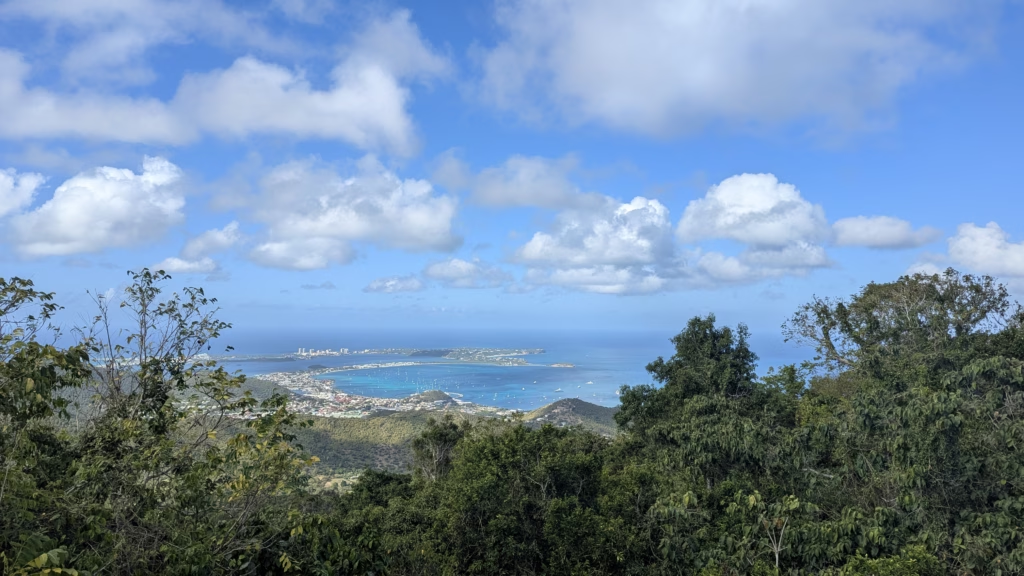
1. Forest / Jungle peak: because he loved nature and the wild.
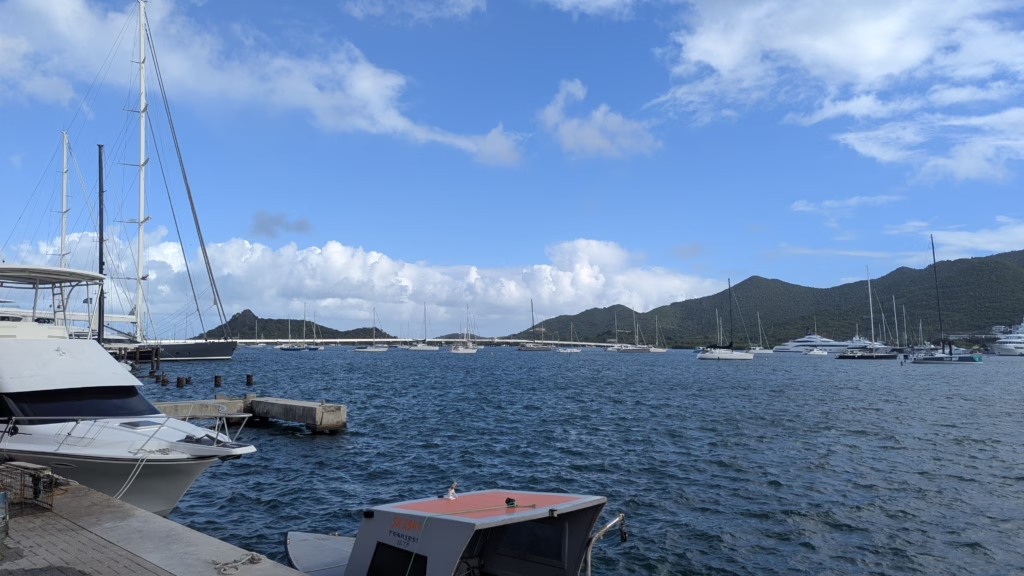
2. Harbor / Fish market: because he loved fishing, boats, kayaks and the untamed waterways.
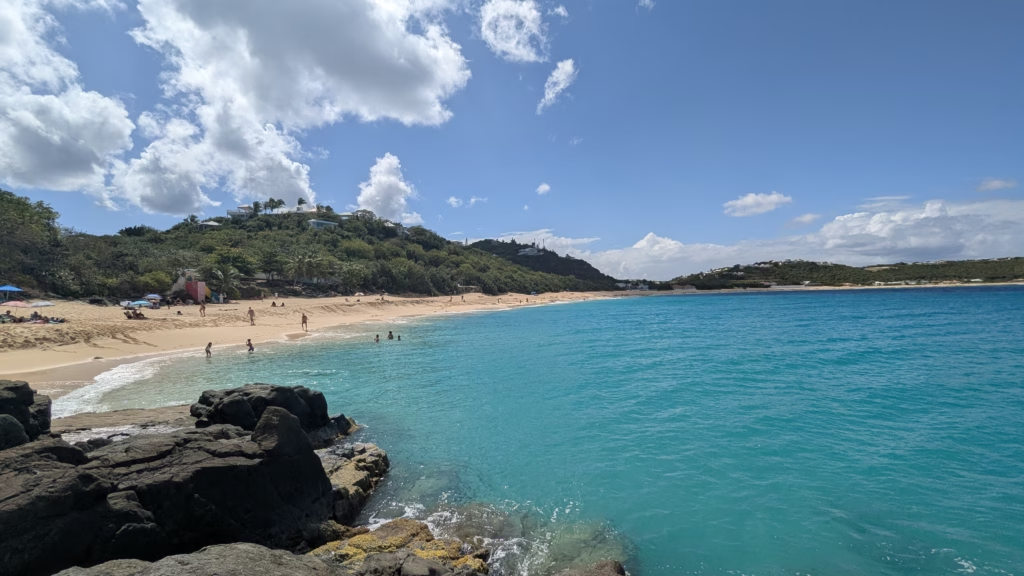
3. Beach: open and sunlit, the place where land and sea shake hands.
4. Rocky ocean shore: where the last portion went into the sea toward the descending light.
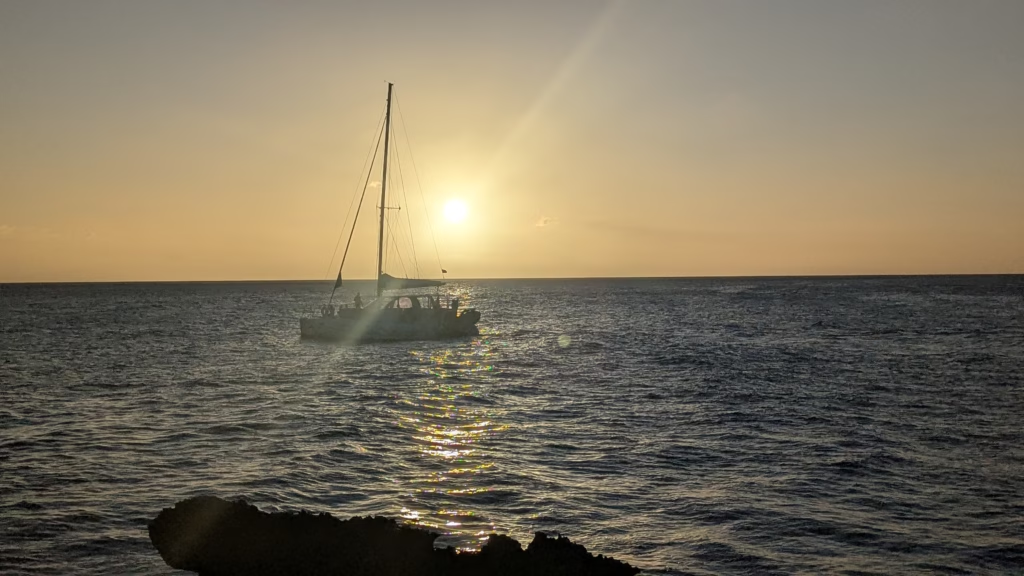
Forest. Harbor. Beach. Sea.
Earth. Work. Sand. Water.
A complete circle of elements, without me meaning to draw it.
As if the world itself wanted the farewell to be whole.
18:00 — the hinge between lights
I did not time the ritual. I didn’t look at the clock. I didn’t wait for an hour. I simply stepped forward when it felt right and cast the last of the ashes into the sea.
Only later, watching the video, did I notice the timestamp:
18:00.
Six in the evening. A hinge between day and night.
In the tarot language, 18 corresponds to the Moon, and I associate that Moon with Hecate, guardian of crossroads and liminal paths. Hecate doesn’t arrive because you schedule her. She appears because you have entered a crossing.
At 18:00, I had already thrown the ashes.
Setting Sun. Present Moon. I took a photo at the time:
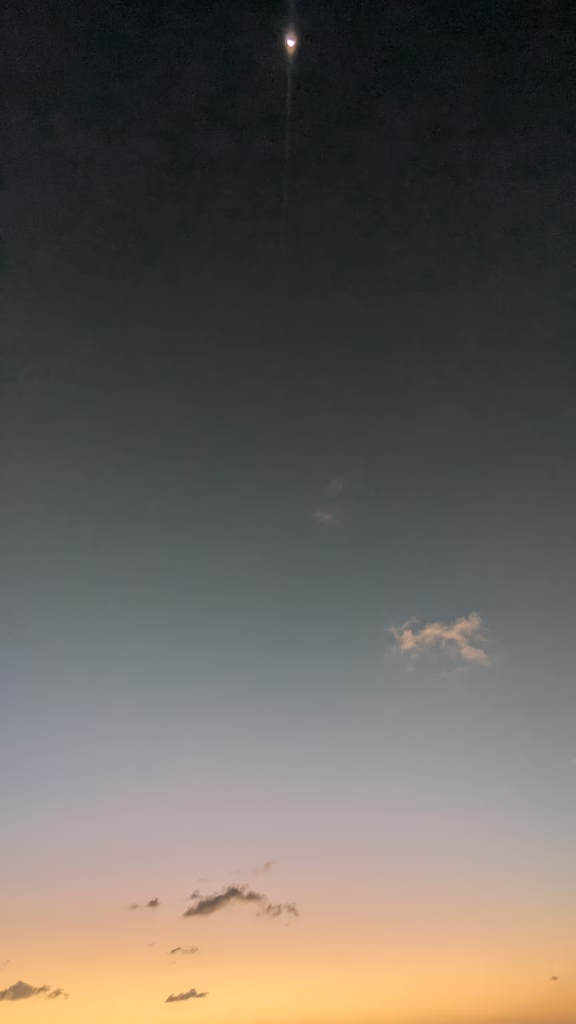
A handoff between lights.
The sky that evening did what skies sometimes do when they decide to speak in colors instead of words: orange and yellow near the sinking fire, violet and darkening blue opening over the bay. The Moon was there, partly lit, waxing, not full, not absent. Becoming.
That is the whole story, isn’t it?
Grief is a waxing Moon.
You don’t return to “full daylight.”
You learn to live in becoming.
And on the walk back to the car after the sunset, fireflies and bats accompanied us.
- Fireflies: small lanterns.
- Bats: living calligraphy of night.
If the Hermit carries a lantern, the forest answered with lanterns of its own. If the Moon guides the dark, the bats wrote the dark’s script in motion.
We were not alone on that trip.
It was my wife, myself, and him.
The figures walking with me
Looking at my own identity through these archetypes.
I see myself as Le Pendu, the Hanged Man, representing Orpheus energy: inversion, descent, altered sight, the one who goes down to retrieve what cannot otherwise be held.
And I read my wife as the Star, representing quiet guidance, promise without noise, the steady light that doesn’t demand anything from you except that you keep going.
The one who descends and the one who keeps the light.
Orpheus and a star.
A song and a lantern.
A journey that continues.
Into the Blue: a walkthrough, verse by verse
When I wrote Into the Blue on 2026-01-26, it didn’t feel like writing a eulogy. It felt like channeling a memoir in miniature. It is not my voice speaking in the verses; it is his. It is the map of his soul’s travelogue, from the moment he arrived to the moment he left.
Here is what the song says when I listen to it as his story, from birth to death.
1) Arrival and Departure
Out of darkness I was born
The light just made me blind
To the shadows I return
With a heavy, quiet mind.
This is the great cycle of existence. He speaks of his own birth, emerging from the mystery (“darkness”) into the overwhelming brightness of the world. And now, at the end of the timeline, the cycle completes itself.
He returns to the shadows. This is not fear; it is the natural closing of the circle. The “heavy, quiet mind” is the accumulation of a life fully lived, the wisdom and the silence that descend when the noise of the world finally ceases.
2) The Life Lived
On the road of life I went
With the engines running wild
At the crossroads I got lost
Just a broken, blinded child.
Here is the Chariot of his years. “Engines running wild” captures the kinetic energy of his life: the motorcycle, the fishing, the boats, the nature, the movement. The sheer force of living.
But every hero’s journey hits its crossroads. Even a father, who seems invincible to a son, knows the feeling of being “lost.” The “broken, blinded child” is the vulnerability that sits at the core of every human being, even the strongest ones, when they face the magnitude of the world alone.
3) The End of the Road
Chasing roads to “I don’t know”
Where the choices go to die
Searching for the secret place
Where the souls and stars align
“Chasing roads to ‘I don’t know'” is the story of the human experience. We spend our lives navigating a series of choices without a clear map. We turn left or right, we make good decisions and bad ones, often without knowing exactly where we are heading or why.
“Where the choices go to die” marks the end of that frantic search. It is the realization that a life cannot be measured just by the turns we took, but by what we were looking for all along.
He—like all of us—was searching for that “secret place.” The alignment. It is the universal hunger for meaning and fulfillment, the desire to find the moment where the confusion of the road settles, and the soul finally feels at home in the universe.
4) The Inheritance of Truth
Blood remembers what is true
Trust what lies inside
Speak the language of the heart
Free your soul and mind
Here, the perspective shifts. He is no longer just describing his own departure; he is sending a signal back across the divide. This is his message from behind the veil to those of us still walking the earth.
“Blood remembers” is his reminder that we do not need to look outside ourselves for the answers. The truth isn’t something we learn; it is something we inherit, something that flows in our veins. He is telling us to trust that deep, quiet instinct that lies beneath the noise of the world. To speak the “language of the heart” is his final instruction on how to live: authentically, intuitively, and without the cages we build for ourselves. It is a father’s ultimate wish for the ones he leaves behind: be free.
5) The Weighing of the Soul
She weighs the heat within the spark
The harvest of the soul
The shape you’ve carved into the dark
To make the spirit whole.
Here, he stands before Themis. She is the ultimate measure, yet her scales are not calibrated for the things the world usually values. She is not weighing his wealth, his status, or his public victories.
She weighs “the heat within the spark.” He is telling us that what matters in the end is the work you do inside—the quiet, grueling work that nobody else can see or measure. It is the lifelong quest to piece together a fragmented spirit, to find wholeness in a broken world. The “harvest” he speaks of is his contribution to the collective spirit of humanity; it is the weight of the knowledge he gained and the lessons he learned, carved out of the darkness not merely to be left behind, but to be integrated into the greater understanding of the whole.
6) Crossing Over
The road dissolves, the debt is paid
She measures how I’ve grown
Into the dark and unafraid
My journey marches on.
The finale. The road of the living dissolves. The “debt” of existence—the minutes on the card he used to talk about—is paid in full.
He steps “into the dark and unafraid.” Not because there is no mystery, but because he is ready. And the most vital line: “My journey marches on.”
Death is not a stop. It is a continuation. His movement continues, just on a different shore, into the blue.
Why I’m releasing this now
I’mI’m placing Into the Blue here today, 2026-01-29, not for an audience, but for memory.
My website is a quiet corner of the internet. There is little traffic here, and these songs are not destined for the charts. Popularity was never the point.
I am leaving this here as a memoir to myself, a way to remember my dad, and an attempt to understand why the music came to me in the first place.
The first song was my candle: walk in light, don’t be afraid, we will meet beyond the shade.
The second song is my threshold: into the blue, into the deepening color where day becomes night and love becomes lineage.
I write this to pay tribute to him. And I write this for the future. Perhaps, one day, my girls will be interested enough to wander back to this date in the archives. Perhaps they will read what I wrote and listen to the music their grandfather inspired, and understand the journey we took together.
So I leave this as an offering.
To my father, whose name the forests will know.
To the sea, which receives without needing to understand.
To the island that taught me what a border can be: not only a division, but a shared holding.
If you are reading this, or if you are my daughters listening years from now: listen like you would watch a sky change.
Not trying to decode it.
Just letting it happen.
And let the music the silence.
Into the blue..