
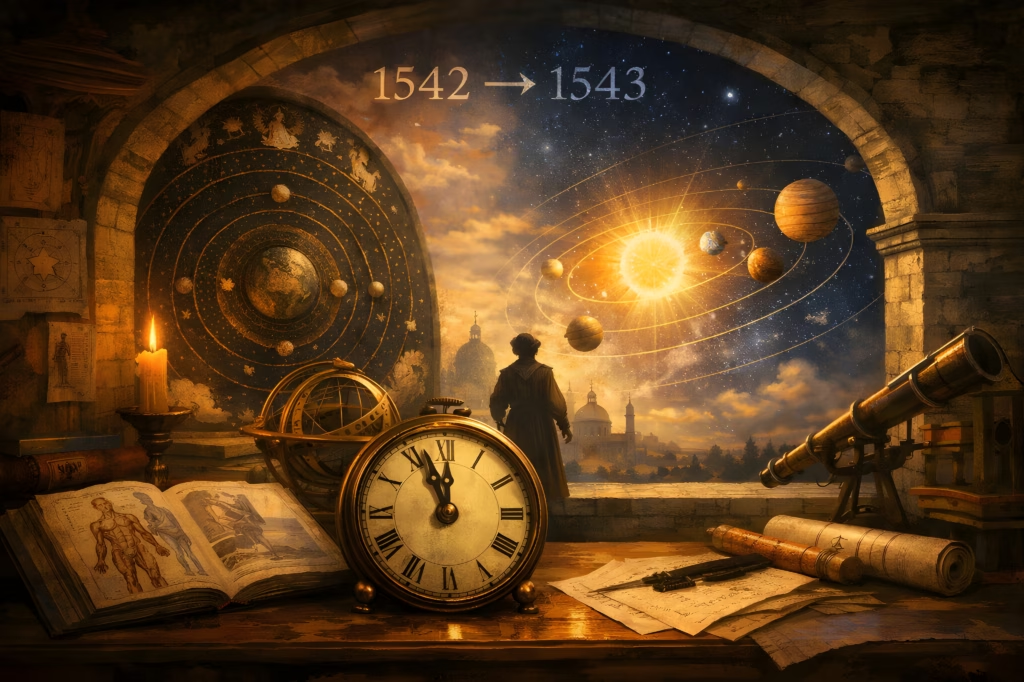
I did not begin with history. I began with a song.
The phrase “fifteen forty-two” arrived first as rhythm, a pulse, a repetition, a clock sounding somewhere beneath the surface of thought. It was about time, or so I believed then, the sensation of suspension, of waiting inside a single second that expands beyond its measure. The refrain came with the mechanical insistence of tick tock, while the verses moved through images of inner signal, fire, glass, and drift. Only later did the number begin to ask for its own meaning.
Curiosity led me to the actual years 1542 and 1543. What I expected to find was a historical footnote, a date among dates, a neutral coordinate in the long chronology of the past. Instead I discovered that these two consecutive years stand at one of the great turning points in the history of human consciousness.
In 1543, Nicolaus Copernicus published De revolutionibus orbium coelestium, removing the Earth from the center of the universe and setting it in motion around the Sun. In the same year, Andreas Vesalius published De humani corporis fabrica, replacing inherited anatomical authority with direct observation of the human body. At almost exactly this moment in European culture, the visual language that would become the Tarot de Marseille began to circulate in printed form, preserving in symbolic sequence the older vision of a meaningful cosmos and the structured journey of the human being within it.
The coincidence was striking. The number that had appeared in the song as a marker of suspended time belonged to a historical threshold, the last instant of a world that understood itself as fixed, centered, and hierarchically ordered, and the first instant of another in which everything moved, the Earth, the heavens, knowledge itself.
What had been a unified cosmology divided into two complementary paths. The external universe became the domain of measurement, mathematics, and observation. The internal universe, meaning, archetype, transformation, moved into image, symbol, and art. The center of reality shifted from a given structure to a journey.
Seen from this perspective, the refrain “fifteen forty-two” becomes more than a date. It becomes a suspended moment at the edge of change, the held breath before the second hand begins to move.
This article begins with that coincidence between a piece of music and a historical discovery. From there it moves outward into the world of the mid sixteenth century, the collapse of the medieval cosmos, the birth of modern science, and the migration of myth from the structure of the heavens into the interior landscape of the human being. It is an attempt to understand how a number, a year, and a song can meet at the same threshold, the moment when time itself seems to change direction.
To understand why these two years carry such weight, we must step into the world that existed before them.
1542–1543: The Turning of the World and the Re-centering of the Human
The years 1542 and 1543 stand at a threshold in the history of human consciousness. They do not mark a sudden transformation visible to everyone living at the time, yet in retrospect they form a hinge between two different ways of understanding reality. In these years the structure of the cosmos, the meaning of the human body, the authority of tradition, and the location of myth all began to shift. What had been a unified symbolic universe, finite, hierarchical, and centered on the Earth, gave way to a world that was expanding, observable, and no longer organized around humanity as its physical or spiritual axis.
For over a millennium the dominant European image of reality had been a synthesis of classical philosophy and Christian theology. The Earth stood motionless at the center of the universe. Around it revolved the perfect celestial spheres, the realm of divine order. The human body mirrored this harmony as a microcosm of the greater cosmos. Knowledge flowed from the past, from Aristotle, from Ptolemy, from Galen, from the Church Fathers. To understand the world was to interpret a received structure whose truth had already been revealed.
By the early sixteenth century this symbolic universe was under pressure from many directions. The Reformation had already fractured the unity of religious authority. Oceanic voyages had revealed continents and peoples unknown to classical geography. Print had begun to circulate texts and images with unprecedented speed. Yet the deeper transformation, the change in the very method by which truth was established, became visible in 1543.
In that year Nicolaus Copernicus published De revolutionibus orbium coelestium. His heliocentric model did more than rearrange the planets. It displaced the Earth from the center of the cosmos and set it in motion as one body among others. The implications were immense. Humanity no longer occupied the fixed point around which the universe turned. The heavens were no longer a set of nested, perfect spheres expressing a theological order. They became a system that could be described mathematically. The cosmos shifted from being a symbolic structure to being a problem in geometry and observation.
In the same year Andreas Vesalius published De humani corporis fabrica, a work that transformed the understanding of the human body. For centuries anatomy had been based largely on the authority of Galen, whose descriptions were derived from animal dissections. Vesalius opened human bodies and drew what he saw with his own eyes. In doing so he replaced reverence for inherited knowledge with direct investigation. Truth was no longer guaranteed by antiquity. It had to be verified through experience.
These two works, appearing together, signal the birth of a new epistemology. The outer universe and the inner structure of the body were both removed from the domain of received authority and placed within the field of observation, measurement, and correction. The method that would later define modern science, empirical, mathematical, self revising, had found its first clear expression.
This transformation did not simply produce new knowledge. It altered the myth by which reality was understood. The medieval world had been held together by a living cosmology in which physical structure, spiritual meaning, and social order mirrored one another. When the Earth began to move and the body became an object of dissection, that unified symbolic system could no longer function as the literal description of the universe.
Yet myth did not disappear. Instead, it migrated.
In the same cultural environment in which the scientific worldview was being born, the images that would become the Tarot de Marseille were taking shape in printed form. The tarot preserves, in symbolic language, the older vision of a meaningful cosmos and the structured journey of the human soul within it. What had once been projected outward as the architecture of the heavens returned inward as a map of consciousness.
This parallel development reveals that the mid sixteenth century was not simply an age of disenchantment. It was a period in which two complementary modes of knowing separated from one another. The external world became the domain of science, quantifiable, observable, and infinite. The internal world remained the domain of symbol, expressed through art, esotericism, and the archetypal sequence of images such as the Major Arcana.
Seen in this light, the early arcana of the tarot offer a striking symbolic reflection of the historical moment. The Fool steps into the unknown, leaving behind the closed and certain world. The Magician stands at a table of tools, representing the new human figure who transforms reality through knowledge and technique, the astronomer, the anatomist, the printer, the navigator. The High Priestess guards hidden wisdom, now no longer guaranteed by tradition but waiting to be discovered. The Empress and the Emperor establish new forms of generation and order, echoing the creation of new intellectual and political systems. The Hierophant, figure of spiritual authority, stands at the point of crisis in a century marked by religious division and the questioning of inherited truth.
Even the numerical sequence present in the years 1542 and 1543, containing the digits one through five, can be read symbolically as a cycle of unity, polarity, creation, structure, and transformation. Historically this is coincidence, yet as an image it mirrors the process unfolding at the time. A beginning is made, an opposition emerges between old and new, a proliferation of ideas follows, new systems take shape, and established authority enters into crisis.
What closes in these years is not a calendar cycle but a two thousand year cosmology. What opens is the modern condition, a universe without a physical center, a body that can be studied as material structure, and a human being who must seek meaning not in a fixed cosmic hierarchy but in an ongoing journey of discovery.
Thus 1542 and 1543 can be understood as a turning of the world. The center of reality moves from a stable, given order to an open, dynamic process. The human being is no longer the axis of creation but becomes the explorer of an infinite external space and an equally complex inner one. Science and symbolism, once united in a single cosmology, begin their long divergence, one mapping the outer universe, the other charting the depths of the psyche.
In this sense, the mid sixteenth century marks not the end of myth but its transformation. The heavens become mathematical. The soul becomes archetypal. The authority of the past gives way to the experiment of the present. The world is no longer a completed structure but a journey, and the human being, like the Fool at the beginning of the tarot, steps forward into a reality that is vast, uncertain, and filled with the possibility of new knowledge.
The Song as Threshold: From 1542 to 1543
Read in the light of this historical transformation, the song Fifteen Forty-Two unfolds as an archetypal passage from one mode of being into another.
The refrain, “Fifteen forty-two … tick tock,” functions as a suspended present. It is a holding pattern, a temporal enclosure in which movement has not yet begun. This corresponds to the historical position of the year itself, the final instant in which the medieval cosmology still appears intact, even as the conditions for its transformation have already formed.
From far below, the signal starts
A frequency within my heart
A shape now gathers in the mind
I leave the moving world behind
Here the center of orientation shifts from the external world to the interior field of perception. Authority is no longer located in the inherited structure of reality but in an emerging consciousness. This mirrors the epistemological transformation of the sixteenth century, in which knowledge begins to arise from observation, investigation, and the activity of the individual mind.
A moment frozen in the glass
While waiting for the storm to pass
A fire carried in my soul
To give me form and keep me whole
The frozen moment evokes a world still enclosed in its old form, while the storm suggests the approaching upheavals of Reformation and scientific revolution. The fire in the soul becomes the new center, no longer the Earth at the middle of the cosmos, but the creative and perceptive human interior.
I drift upon the silent stream
Awake inside a living dream
The current slows, the vision clears
Dissolving all the wasted years
This drifting corresponds to the Copernican condition. In a heliocentric universe the ground is no longer fixed. Everything is in motion. The human being awakens not at the center of a stable structure but within a dynamic and unfolding reality.
The second hand begins to flee
A shift in my reality
I blink my eyes and I can see
It’s fifteen forty-three
Time, which had been suspended, accelerates. The universe moves. Perception changes. The passage from 1542 to 1543 becomes the symbolic equivalent of the transition from a closed, hierarchical cosmos to an open, infinite one.
In this sense the song enacts in miniature the same shift that occurs in the sixteenth century, the relocation of the center from an external, given order to an inner, experiential journey. What had once been expressed as the structure of the heavens becomes the movement of consciousness itself.
The ticking clock of the refrain is therefore not only the sound of time passing. It is the sound of a world on the threshold, the last second before motion, and the first second of a new reality.
A Second 1543
If the sixteenth century marked the moment when the Earth was removed from the center of the cosmos, our own time seems to be moving through an inverse recognition. Not a return to a medieval astronomy, but a return of centrality at another scale. The center is no longer a physical location in space. It is consciousness itself.
In recent years the language of awakening, transformation, and inner realignment has moved from the margins into the shared vocabulary of ordinary life. What was once the domain of mystics and initiatory traditions has become a lived experience for many. The structures that appeared fixed only a decade ago have begun to dissolve. Time accelerates. Identity becomes fluid. Meaning is no longer received from a stable external order but formed through direct encounter.
In this sense the present moment carries the atmosphere of another threshold. A new 1543.
The scientific revolution displaced humanity from the center of the physical universe. The transformation now unfolding restores the center, not to the Earth as an astronomical object, but to the human as a field of awareness. The axis of the world is no longer above or below. It is within.
Read from this perspective, the song becomes not only a meditation on a historical passage but a map of an initiation.
The opening refrain, repeating the number like a clock, marks the period of gestation. A life lived inside structures that are already beginning to lose their reality. The sense that something is about to change without yet knowing how.
Fifteen forty two. Tick tock.
The signal that rises “from far below” is the call of the deeper self. It does not arrive from the sky of authority but from the interior ground of being. The leaving of the moving world behind is not withdrawal from reality but withdrawal from a reality defined by external motion, expectation, and inherited identity.
The frozen glass is the suspended life. The storm is the necessary dissolution. The fire carried in the soul is the indestructible continuity of the self that passes through transformation without losing its form.
In the chorus the movement changes. Drifting upon the silent stream is the discovery that the current was always there. Awakening inside a living dream is the recognition that what we called the world is also a field of perception. The wasted years dissolve because time itself is reconfigured. Past and future lose their weight when the center is found in the present.
Then the moment arrives.
The second hand begins to flee.
In the historical sixteenth century this was the moment when the Earth began to move. In the personal and collective present it is the moment when identity begins to move. The fixed self dissolves. The inherited cosmology of the individual life is replaced by direct vision.
It is fifteen forty three.
This is not a date. It is a state of consciousness.
To say that we become the gods of old is not to claim dominion over the world but to remember the creative nature of awareness itself. In the ancient cosmologies the gods were not distant supernatural beings. They were personifications of forces that shaped reality. To rediscover that the shaping force is within perception, within imagination, within the heart, is to return to a form of centrality that the Copernican revolution could not abolish.
The Earth becomes the center again because the place in which we stand becomes the axis of meaning. Every point is the center when consciousness is present.
In this sense the movement from 1542 to 1543 is not finished. It is a recurring passage. A rhythm in history. A rhythm in individual lives.
There is always a suspended year in which the old structure still appears to hold. There is always a following year in which vision shifts and the universe begins to move.
The ticking of the refrain continues, but it is no longer the sound of time running out. It is the sound of emergence.
And the realization returns, not as history but as experience.
It is fifteen forty three.